Every year, districts across the country launch new initiatives aimed at improving teaching and learning. Curriculum adoptions. Instructional coaching programs. Professional learning communities. Technology integrations. The investments are real, the intentions are good, and yet the results are persistently mixed or disappointing. Some initiatives take hold and produce lasting change. Many others fade quietly after a year or two, leaving little trace.
What separates the initiatives that work from the ones that don’t? The answer is rarely about the strategy itself. It almost always comes down to whether the work was built on a clear, shared theory of action.
What Is a Theory of Action?
A theory of action is a blueprint that connects your actions to your intended outcomes. It specifies the chain of cause and effect: identifying what changes need to happen, in what order, and why those changes are expected to produce the results you’re after.
Put simply, a theory of action answers the question: If we do X, we believe Y will happen, because Z. It makes your assumptions explicit so you can test them, refine them, and hold yourselves accountable to them.
This might sound like a planning document or a logic model, and there is some overlap. But a theory of action goes further. It doesn’t just describe inputs and outputs; it explains the mechanism. It articulates why your chosen approach is expected to produce the outcomes you want, tracing the causal chain from your actions all the way to the students you are ultimately trying to serve.
The Hidden Cost of Implicit Theories
Here is the uncomfortable truth: every educational initiative already operates on a theory of action, whether leaders have articulated one or not. Every program rests on assumptions about what educators should do and why those actions will lead to better outcomes for students. The question is whether those assumptions are examined and shared or are left implicit and unexamined.
When theories of action stay implicit, different stakeholders end up pulling in different directions without realizing it. For example, a curriculum adoption assumes teachers will need support interpreting new materials, but the professional development provided assumes teachers need support with classroom management. Or a coaching program invests in relationship-building skills, but the district evaluates coaches on the number of times they were in teachers’ classrooms. Everyone is working hard, but the work isn’t connected.
Implicit theories also make it nearly impossible to learn from experience. When results are disappointing, you can’t diagnose the problem because you never clearly stated what you expected to happen. Was the strategy wrong? Was the implementation weak? Were the preconditions never in place? Without an explicit theory, these questions have no good answers.
Thinking in Systems
One reason explicit theories of action are so valuable is that they force leaders to think in systems rather than in isolated programs. Meaningful educational change doesn’t happen in a single layer of the organization, it moves through the system. District decisions shape school conditions. School conditions shape what teachers can do. What teachers do shapes what students experience and learn.
This means that designing any change initiative requires tracing the full chain from your point of intervention all the way to student outcomes. What do you want students to know and be able to do? What teaching practices produce that kind of learning? What conditions — knowledge, skills, time, support, materials — do teachers need to develop those practices? What does your initiative need to provide to create those conditions?
Each link in that chain is an assumption worth making explicit. When you do, gaps become visible. You may find that your initiative addresses one link in the chain while leaving others untouched. You may find that different parts of your organization hold different beliefs about what good teaching looks like. This is a problem that will quietly undermine even the best-designed programs until it’s surfaced and worked through.
Coaching as an Example
Instructional coaching offers a useful illustration of what happens when a theory of action is and isn’t present.
Coaching has become a popular strategy for improving teaching, and the research is clear that it can work. But the research is equally clear that hiring coaches doesn’t automatically produce results. Some approaches are significantly more effective than others, and simply placing coaches in schools — without a clear theory of what coaches should know, what they should do with teachers, and how that will translate to changes in the classroom — produces disappointingly inconsistent outcomes.
The problem isn’t coaching as a strategy. The problem is that coaching is too often deployed as a solution before anyone has worked through the logic connecting coach actions to teacher learning to student outcomes. Districts select and train coaches without clarity on what competencies matter most. Coaches focus on whatever seems most pressing without a shared framework connecting their work to a larger purpose. And when results are uneven, no one quite knows what to change.
When our team (Lynsey along with Jim Hiebert, Jamila Riser, and Val Maxwell) went to develop a theory of action for a mathematics coaching initiative, the process looked quite different. We started with student learning — specifically, what it means for students to make sense of mathematics rather than simply follow procedures. We then worked through each role group: what teaching practices support that kind of learning? What do coaches need to understand about mathematics, teaching, and teacher learning to help teachers develop those practices? What do coaches themselves need to experience in their own professional learning?
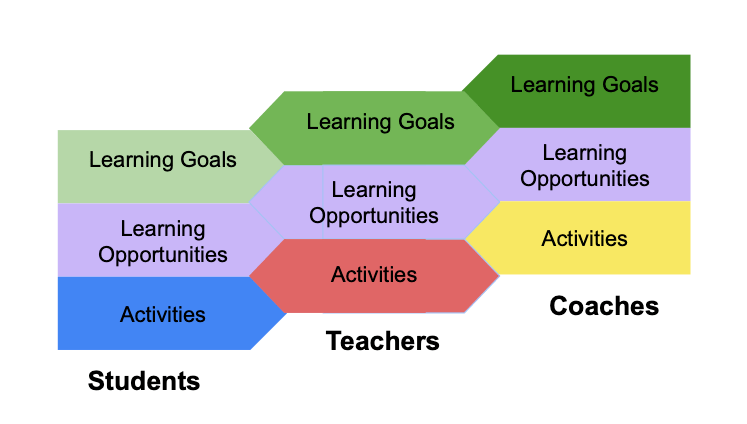
Image of important components in our Theory of Action for Coaching
Building out this chain of reasoning made our assumptions visible and, crucially, made them testable. It also created coherence across every component of the initiative: coach selection, coach learning, the structure of coaching cycles, and how we evaluated progress.
Making the Theory Explicit
For district leaders, the work of developing an explicit theory of action begins with a few foundational questions:
What outcomes are we ultimately trying to achieve for students and how specifically can we describe them? What changes in teaching are most likely to produce those outcomes? What conditions need to be in place for those teaching changes to take hold? And what role does our initiative play in creating those conditions?
These questions don’t have easy answers, and that’s the point. Working through them, together across roles and levels of the system, is itself the work. And it takes time. The theory of action we created for coaching took over 8 hours to articulate. The conversations surface hidden disagreements, reveal gaps in the current plan, and build the shared understanding that sustains an initiative through the inevitable difficulties of implementation.
The goal is not a perfect document. It is a living framework that your team returns to, tests against evidence, and revises as you learn. That habit of reflective, theory-driven practice is what distinguishes districts that keep getting better from those that keep starting over.
Educational change is hard. The initiatives most likely to succeed are the ones built on an explicit account of how they expect change to happen. A theory of action isn’t extra work on top of the real work. It is the real work.
The ideas in this post are influenced by the following scholars: Tony Bryk, Victor Friedman, Ron Gallimore, Jim Hiebert, Katherine McKnight, Jamila Riser and Val Maxwell
Want to know more? Visit this link to read: Theories of Action Needed to Guide Emerging Models for Professional Learning An Examination of a Theory of Action for Instructional Coaching


Leave a Reply