In classrooms, we talk about what high-quality interactions between teachers and students look like, knowing the quality of those interactions impact what students learn. We can ask the same thing in teachers’ interactions with their colleagues. So what are the conversations that are of a quality that actually impact teaching? Research on teachers’ collaborative conversations has a lot to teach us about this.
There are a few key reasons why collaboration matters so much for teachers. First, teaching is a profession where working with others allows colleagues to pool their knowledge and expertise, leading to better decisions for the students they serve. Second, knowledge isn’t something developed in isolation. It’s built socially, through everyday interactions and shared experience. This means that collaborating with colleagues—talking, working alongside one another, and learning from each other—is one of the most effective ways teachers grow their own skills and understanding. Third, collaboration opens the door to new ideas and practices that simply can’t emerge when teachers work alone. When teachers come together regularly to talk through ideas and make decisions as a group, it sparks new ways of approaching their work, builds shared understanding, and deepens collective knowledge over time.
Defining High-quality Interactions: Enter The Instructional Triangle
To understand what makes a conversation high-quality, it helps to start with a framework called the instructional triangle, developed by researchers David Cohen and colleagues, which describes the three elements that shape learning experiences in classrooms: the teacher, the students, and the content. It turns out that the instructional triangle is also useful for thinking about what makes for productive interactions with teachers that allow them to analyze teaching, which has a better chance of impacting their teaching.
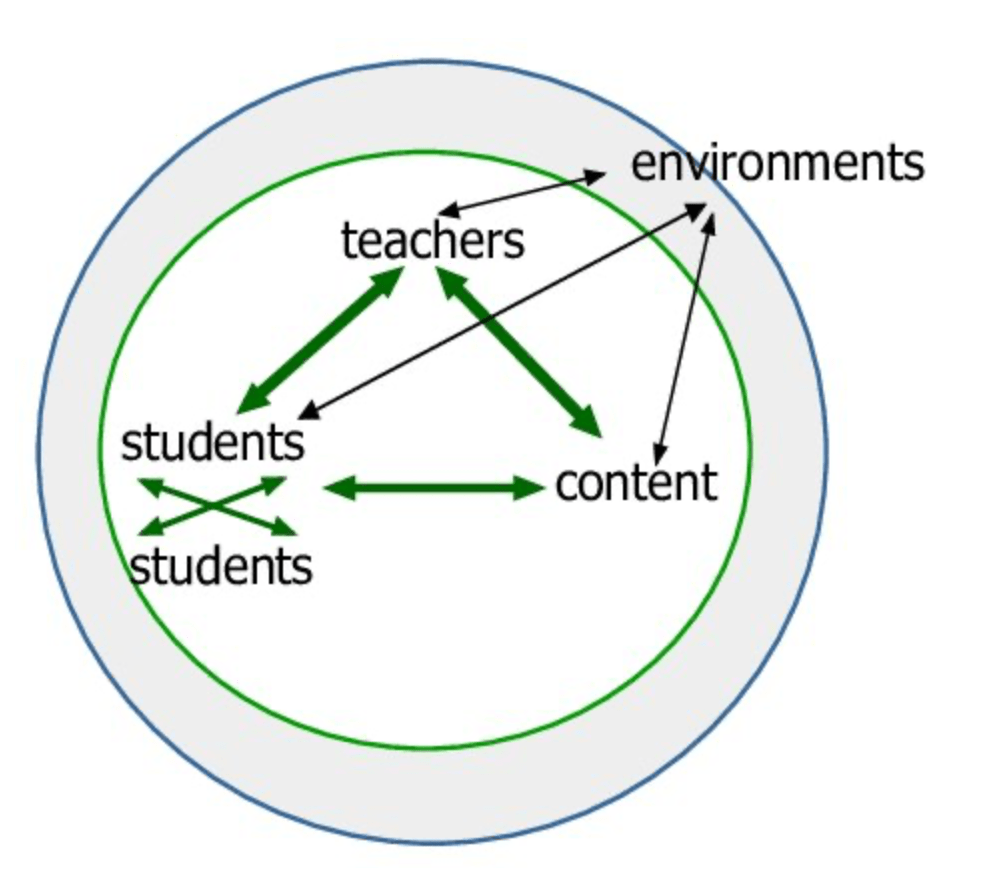
Figure from Cohen, Raudenbush & Ball, 2003
Copyright 2003 by the American Educational Research Association
What the Research Tells Us
Researchers at the University of Pittsburgh spent years studying what kinds of conversations between teachers and coaches actually predict improvement in student learning — specifically, increased opportunities for students to engage in deeper conceptual thinking. They found that rather than addressing teacher, student, and content separately in sequence, the most powerful conversations held all three in view.
Researchers at the University of Pittsburgh didn’t stop at showing that productive coaching conversations connect students, content, and pedagogy. They dug deeper to find out what specifically made some conversations more powerful than others for improving teaching. By studying planning conversations between teachers and coaches, they identified three key features that set the most effective conversations apart:
1. They went deep.
Instead of staying at the level of pacing or logistics, these conversations dug into substantive questions: Why does this mathematical idea matter? How are students likely to think about it? What instructional moves will best support that thinking?
2. They got specific.
Rather than discussing general strategies (like “try more turn-and-talk”), these conversations named actual students, referenced specific tasks, and anticipated real student responses. For instance, a teacher and coach might talk through how particular students would likely think about a key idea before the teacher poses a pivotal question, planning for that exact moment rather than speaking in generalities.
3. They regularly connected the vertices.
The strongest conversations didn’t address students, content, and pedagogy as separate topics. Instead, they wove them together. The example above does just that: anticipating how specific students will reason about a specific mathematical idea informs the specific pedagogical choice of when and how to ask a key question.
Other researchers have found the same thing: high-quality interactions for teachers regularly connect the three vertices of the instructional triangle. What are the implications of this for coaches and principals? Read Parts 2 and 3 of this three-part series to find out.
The ideas in this post are influenced by the following scholars: Daniel Chazan, Patricio Herbst, Jim Hiebert, Ilana Horn, Kelly McKie, Jennifer Russell, Mary Kay Stein, and other researchers at the University of Pittsburgh


Leave a Reply