Instructional decision-making — the choices and moves teachers make during the enactment of instruction — has become a central construct in our work with district and school leaders for understanding how to support teachers and the learning opportunities made available to students.
At the heart of this work is a question we return to throughout The Evolving Educator: What kinds of classroom experiences do we want every child to have, and what conditions enable educators to create those experiences?
In the post Our North Star: The Classroom Experiences We Want for Every Child, we describe classrooms where students are sense-makers, their ideas matter, and teachers are both guides and learners. Instructional decision-making is one of the ways that vision becomes visible in practice. What a teacher chooses to pursue, question, represent, or make public shapes the opportunities students have to engage in meaningful learning.
The Scope of the Construct
Research estimates that teachers make as many as 1,500 decisions in a single school day, many of them related to instruction. Instructional decisions require judgment calls: moment-to-moment choices about lesson content, instructional techniques, student grouping, permissible noise level, and supporting student participation, among many others. The volume of these decisions underscores an important point for instructional leaders: the quality of a lesson is not determined solely by its design, but also by the accumulation of enacted choices that occur throughout as the teacher teaches it. A substantial proportion of these decisions has a direct effect on students’ classroom experience, including their access to content, their opportunities to participate, and, over time, their developing sense of identity as learners.
Sources of Influence on Teacher Decisions
The research literature identifies several interacting influences on how teachers make instructional decisions:
- Instructional goals. The outcomes a teacher is working toward in a given moment shape which options are even considered.
- Professional knowledge. Decision-making draws on three interrelated knowledge domains: content knowledge (subject-matter expertise), pedagogical knowledge (general understanding of teaching and learning), and pedagogical content knowledge (the specialized knowledge of how to make particular content accessible to particular learners).
- Available resources. Time, materials, curricular structures, and classroom conditions constrain the feasible set of decisions in any given moment.
- Professional commitments. Teachers hold commitments toward their students, toward the discipline they teach, toward the institution of schooling, and toward their own professional values — all of which shape, often implicitly, the decisions they make.
- Students in front of them. Teachers closely monitor the students in front of them and consider how they are responding to the content and to each other.
For instructional leaders, this framework suggests that interactions with teachers that are focused narrowly on what they are doing, without attention to underlying knowledge, goals, or commitments, is unlikely to shift decision-making in a lasting way.
Anticipated Versus In-the-Moment Decisions
A useful distinction is between decisions that can be anticipated and planned for, and those that must be made in real time. Clarity about a lesson’s key learning goals supports teachers in planning how to facilitate discussion and how to help students make connections among ideas — this is the portion of decision-making that benefits most directly from lesson design and preparation.
However, some instructional decisions cannot be resolved in advance. In-the-moment decisions arise continuously as lessons unfold in response to student thinking, unanticipated contributions, and shifting classroom dynamics. A brief classroom vignette illustrates this well: when a student offers an unexpected solution method, the teacher must decide, in real time, whether to pursue it, redirect toward the planned approach, or open it to the whole class for collective examination. The decision is made live, drawing on the teacher’s knowledge, goals, and commitments as described above.
How Teachers Develop Decision-Making Expertise
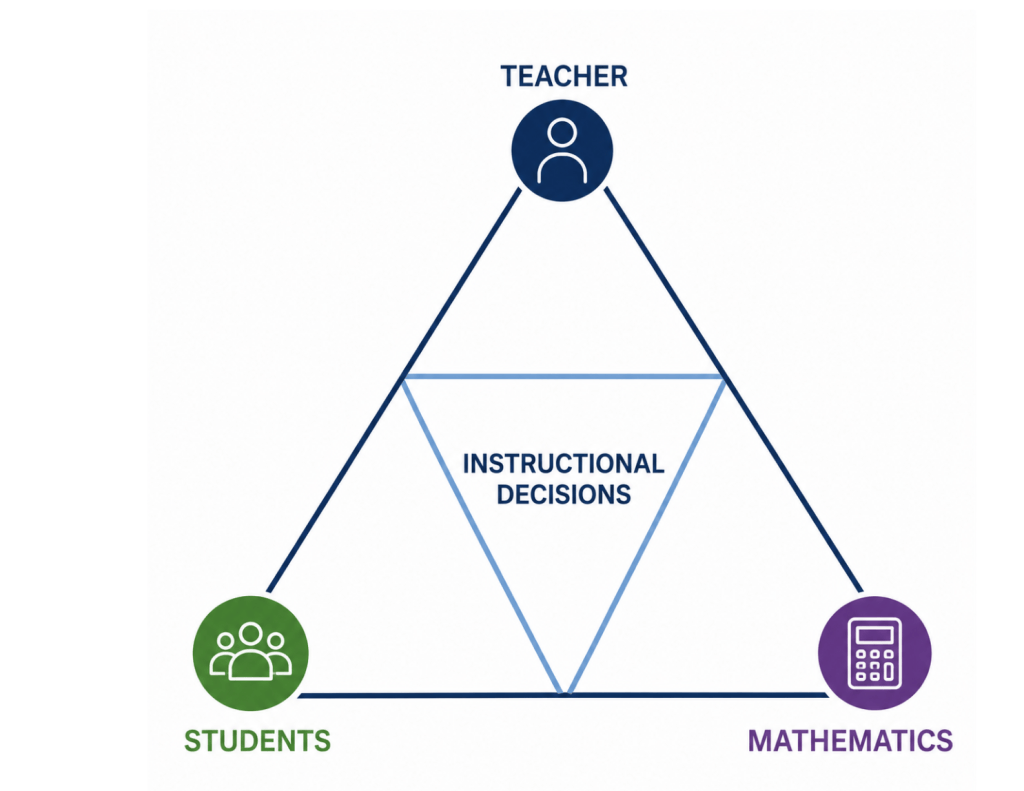
A key finding from the research base is that teachers improve at instructional decision-making primarily through interaction with colleagues — specifically, discussions that connect three elements: students, content, and pedagogy. This is sometimes represented as an “instructional triangle” which we unpacked in an earlier post. Teacher discussions that support their learning are most productive when they draw upon and make connections among these three elements, rather than treating them in isolation. For example, a productive conversation might examine how students’ emerging understanding of a specific mathematical idea can be surfaced and developed through asking a particular set of questions to students, as the lesson unfolds.
Real-Time Support: The Case for Co-Learning
Beyond structured PLC collaboration, there is evidence for the value of real-time, in-classroom support for teacher decision-making. One approach is for principals and coaches to support many teachers’ instructional decision-making directly, in real time, across the school. This reflects the idea that decision-making expertise develops through supported, in-the-moment practice, not solely through retrospective reflection. This model is called co-learning and has the following features:
- It is not scheduled in advance and does not require a pre-conference or post-conference.
- The principal and/or coach moves through classrooms attuned to the specific realities of that day’s lesson enactment, with that particular group of students.
- It is grounded in situated learning theory, which holds that learning occurs most effectively in practice — at the elbow of another person who can support the learner in grappling with the uncertainty inherent in teaching, and who can offer feedback as the teacher deliberately practices new ideas in authentic settings.
The principal and/or coach stays for 10–15 minutes, allowing them to see how a lesson is enacted across multiple same-grade-level classrooms. Spending just a few minutes in each classroom allows the principal and coach to get a pulse on how students are taking up the big mathematical ideas, as well as what decisions the teacher is making as the lesson unfolds. This presence also allows them to engage in that decision-making process, influencing both the course of the lesson and the teacher’s learning. It also solves the problem of only getting into some classrooms: instead, principals and coaches can be in many classrooms across the school over the course of a week.
The value of this approach is closely connected to a prior post: Coaching for Individuals or Systems: How You Set It Up Matters. In that post, we explore how coaching can be organized to build collective capacity rather than operating primarily through isolated, individual support. Co-learning extends that idea into classroom practice by positioning the principal and coach as thought partners in the ongoing work of teaching and learning.
Implications for Instructional Leadership
Following a curriculum or teacher’s edition faithfully is not sufficient for effective teaching. Skilled instructional decision-making requires teachers to reason through situations such as:
- Introducing a new representational tool to help students address a nonstandard mathematical claim
- Deciding whether to intervene with direct explanation or to wait for students to notice and self-correct an error
- Strategically sequencing student contributions to structure a productive whole-class discussion
- Adjusting instructional language to support conceptual understanding (e.g., supporting students to make connections to the contextual features of the task when describing their calculations)
- Exercising discretion in interpreting student behavior and determining appropriate responses
- Regulating classroom norms and logistics, such as noise level, movement, grouping structures, homework policy, and testing procedures
Each of these decision types carries consequences for students’ access to the lesson and, cumulatively, for their identity as learners and doers of the discipline. For principals, this reframes the purpose of classroom observation and feedback: rather than evaluating fidelity to a script, observation can be used to surface and discuss the decision points a teacher navigated, the reasoning behind those choices, and alternative moves that might have been available.
The ideas in this post are influenced by the following scholars: Deborah Ball, Brette Garner, Ilana Horn, Becca Lewis, Alan Schoenfeld, and Taylor Stafford


Leave a Reply