In a recent post, Teacher Instructional Decision-Making: A Framework for Instructional Leaders, we wrote about the hundreds of decisions teachers make as they enact instruction and the knowledge, goals, commitments, resources, and understanding of students that influence those decisions. We also distinguished between decisions that can be anticipated in planning and those that have to be made in the moment, as students share ideas and a lesson unfolds.
That post left us thinking about another question: How do we actually get better at making those decisions?
Recently, we had an opportunity to explore that question while learning alongside a small group of coaches and site leaders. Rather than simply talking about instructional decision-making, we put ourselves in a situation where we would surface and make some of those decisions together.
The curriculum as a starting point
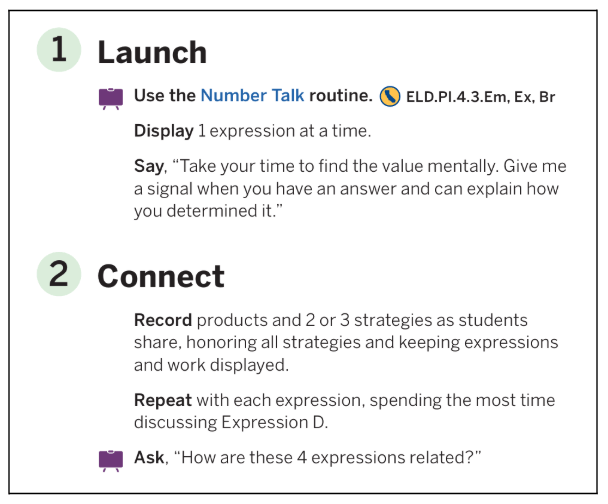
Amplify Desmos Math (2026)
This is learning experience we’ll talk about was situated in a fourth grade classroom using the newly adopted instructional materials. Students would engage in a number string with the following problems:
2 × 12, 4 × 12, 8 × 12, and 16 × 12
The lesson goal: “Students multiply 12 by different factors to develop fluency with doubling as a strategy for multiplication when a factor in 1 product is twice a factor in another product.”
The curriculum (Amplify Desmos, 2026) provided an important base. It gave us a mathematical destination and guidance for getting there. But it didn’t, and couldn’t tell us exactly what to do once a particular group of students began sharing their thinking.
High-quality instructional materials are necessary, but they are not sufficient. As we wrote in our earlier post, the quality of a lesson is shaped not only by its design but by the accumulation of choices a teacher makes while enacting it.
In our session, we planned for the number string, anticipated student thinking, and then took our plan into a fourth-grade classroom to see what happened.
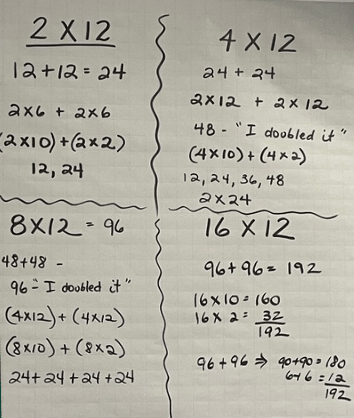
We started by doing the math ourselves and then anticipating strategies students might use.
As we worked, we considered decisions teachers might need to make both in planning and in the moment, in light of our instructional goal for students.
Some of the planning decisions included:
- Should we show students the whole string at once or share one expression at a time?
- Should we represent student ideas electronically on the publisher slide or on chart paper?
- How much time should we spend on each problem?
- When might we intentionally create an opportunity to hear from more students?
- What student thinking would be particularly useful to surface given the mathematics we hoped students would understand?
And we knew there would be decisions we couldn’t make until we were actually with students:
- Which student ideas should we pursue?
- How should we represent a particular idea a student shares?
- What question might we pose in response to a particular idea?
- How might we help other students make sense of someone else’s thinking?
Already, we can see the complexity of facilitating this number string and the numerous decisions we would be making in the classroom.
Getting more specific about our plan
As we considered our context, a particular class of fourth-grade students, we knew we wanted to create opportunities to elicit student thinking so we could understand what students were making sense of and decide which ideas to bring forward in relation to the learning goal.
That required another set of decisions: When would we elicit student thinking? How would we do it? And what would we listen for?
We decided that after posing the second problem, 4 × 12, we would invite students to turn and talk: Explain to your partner how you solved the problem.
While students talked, we would listen in, monitoring for students who used the doubles relationship between 2 × 12 and 4 × 12—perhaps reasoning, I know 2 × 12 is 24, so I can double 24 to get 48.
We were also ready with an important question if we didn’t hear any students connect to the prior problem when they described their strategies: How could you use 2 × 12 to figure out 4 × 12?
This was an important shift in our planning. We weren’t simply planning what we would do. We were planning for what we hoped to learn about students’ thinking, and how we would respond to student thinking.
Then we tried it
Two principals volunteered to take on the “lead teacher role” in the classroom, with the rest of us sitting on the carpet listening to students and serving as thought partners to the colleagues leading the lesson. We had all planned the lesson, and we were all part of its enactment.
In the fourth grade classroom, we heard a range of strategies, many we had anticipated and a few we hadn’t. And suddenly the questions we had been discussing hypothetically became real.
Which idea should we bring forward? What should we ask next? How should we represent this student’s thinking? How do we help the rest of the class engage with the idea rather than simply watch us record it?
Bella shared, “You can double it.” One of the principals pressed her thinking: “Can you say more? What do you mean by ‘you can double it’?” As Bella explained, the other principal recorded her thinking: 2 × 12 = 24, followed directly below by 2 × 12 + 24. Bella continued, “Put them together and it’s 48.”
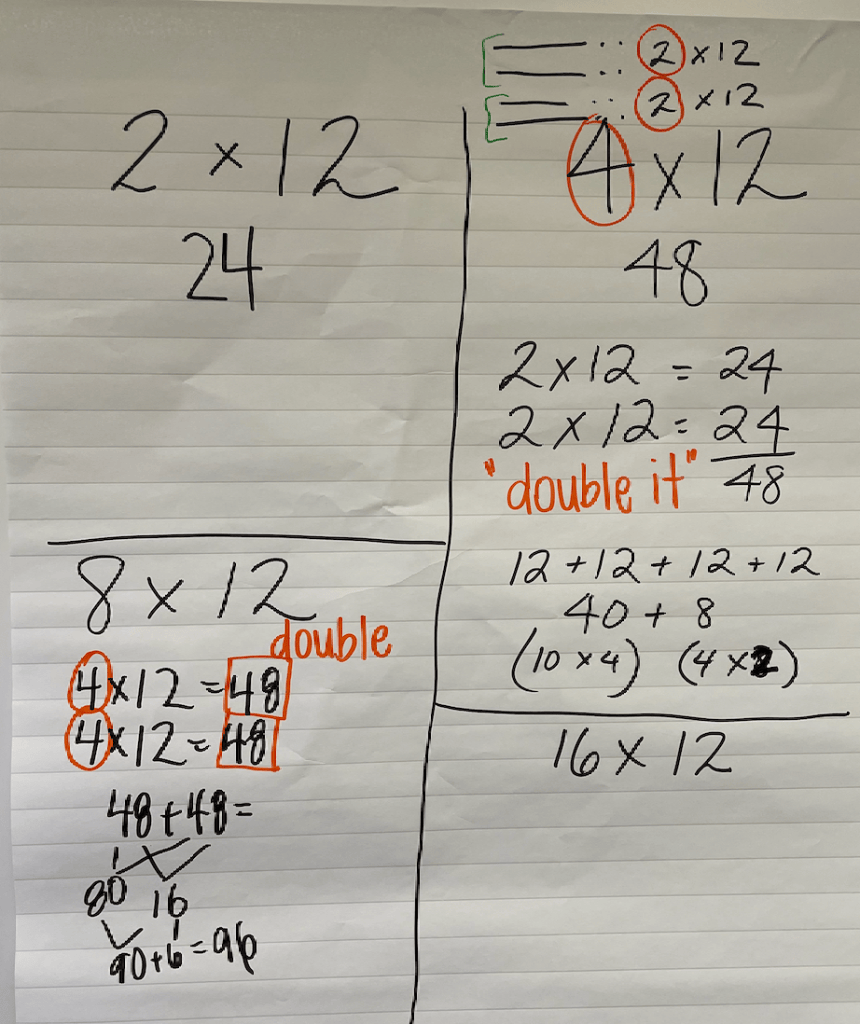
At that point, one of the principals paused the instruction and turned to the other educators: “Would this be a good time to add a representation?” The group quickly agreed. Together, they made an in-the-moment decision to represent Bella’s idea using tens and ones—a representation familiar to the students—to make the doubling strategy more visible and accessible to the class.
This brief exchange captured what we had been exploring. There wasn’t a script telling us exactly how to respond to Bella’s idea. We had to listen, interpret her thinking, and decide together what might help the class make sense of the mathematics. Instructional decision-making isn’t about finding the one “right” move; it’s about making purposeful choices in response to students, the mathematics, and the learning goal.
And those decisions weren’t being made by one person alone. The two lead teachers were responding to students and to one another. Those of us sitting on the carpet were listening with the same learning goal and anticipated strategies in mind. We had developed a shared lens through planning, and now we were using that lens to make sense of what was happening in real time.
What I keep thinking about
We’ve continued thinking about this experience because it made something from our earlier post much more tangible for us: instructional decision-making can be learned, and it can be learned collectively.
Teachers make an extraordinary number of decisions each day. Yet so many of those decisions are made within the isolation of an individual classroom. If instructional decision-making is central to the learning opportunities students experience, how might we create more opportunities for educators to work on those decisions together?
The experience also made me think differently about the learning of principals and coaches.
If principals are going to serve as instructional leaders, they need opportunities to develop their own understanding of content, pedagogy, student thinking, and the decisions teachers are navigating—not simply tools for observing whether particular practices are present. Our earlier post suggests reframing classroom observation in just this way: from evaluating fidelity to a script toward surfacing the decisions teachers navigate, the reasoning behind them, and the alternative moves available. And coaches need opportunities to develop that same decision-making expertise if they are going to be genuine thought partners to teachers.
Perhaps, then, one of our most important responsibilities as instructional leaders is to create more opportunities for educators to make, examine, and learn from instructional decisions together. That might mean planning together and anticipating student thinking. It might mean rehearsing questions or representations before entering a classroom. It might mean sitting alongside one another as students work, trying something, and then asking, What did we notice? Why did we make that move? What might we try next?


Leave a Reply